Showing posts with label Latin America. Show all posts

Christ the Redeemer Statue, Brazil


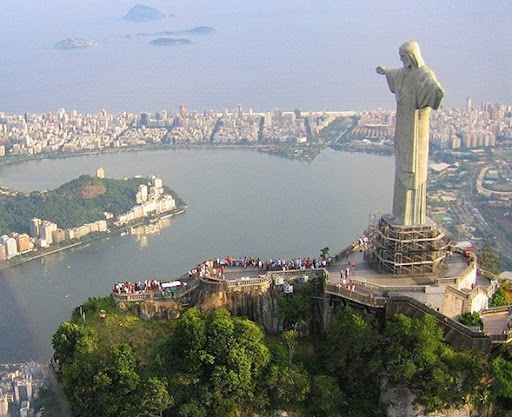
Christ the Redeemer, or Cristo Redentor, is a 32m tall statue in Rio de Janeiro, Brazil. It sits at the top of the 710m (2330ft) Corcovado mountain, in the Tijuca Forest National Park, overlooking Rio de Janeiro. The idea to put a statue at the top of Corcovado can be traced back to the mid 1850s, but was dismissed when Brazil became a republic in 1889, and a law was put in place separating the church from the state. It wasn't until 1921 that the idea of building a statue was revisited. This time, it was spearheaded by the Archdiocese of Rio de Janeiro, which organised a fund raising for it. Donations came mostly from the Brazilian Catholic community. Among the designs proposed included a cross, a statue of Christ holding a globe, and a pedestal representing the world. Eventually the design of Christ with open arms was chosen. As with many structures from the 1920's, the statue was designed in the Art Deco style which was all the rage then. The monument was sculptured by French sculptor Paul Landowski. Engineer Heitor da Silva Costa oversaw the project. The team of engineers and technicians decided to construct the statue of reinforced concrete, and clad its outer layer in soapstone, which has high resistance to extreme weather. The stones came from Limhamn, in Malmö, Sweden.
clip_image002
Aerial view of Cristo Redentor, the statue of Christ the Redeemer, Rio de Janeiro, Brazil
by Klaus with K, http://commons.wikimedia.org/wiki/Image:Corcovado_statue01_2005-03-14.jpg, used under GNU Free Documentation License

The statue of Christ the Redeemer was inaugurated on 12 October 1932 by Brazilian president Getúlio Vargas in a lavish ceremony. In October 2006, in celebration of the 75th anniversary of the statue, the Archbishop of Rio de Janeiro Cardinal Eusebio Oscar Scheid consecrated a chapel under the statue so that Catholics can hold baptisms and weddings there. The chapel can accommodate 150 people at any one time.

Where in the world is Christ the Redeemer Statue?
clip_image001
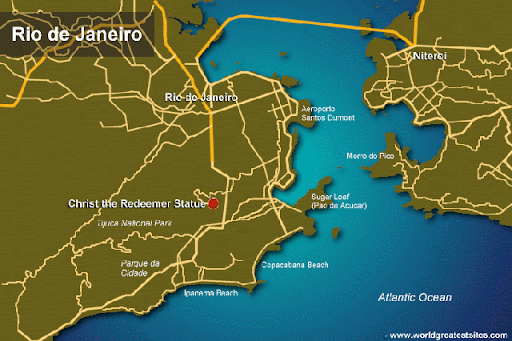
Location of Christ the Redeemer Statue in Rio de Janeiro, Brazil

How to go to Christ the Redeemer Statue ?

You can take a taxi right to the top, or catch the small red train that goes up the hill. Buy the tickets at Rua Cosme Velho 513. The train goes right to the foot of the statue, and you get the stunning panoramic view of Rio de Janeiro spread out before you. The journey takes 17 minutes and the train leave every 30 minutes.

At the top statue, you still need to climb some stairs to reach the base of the statue. The view at the top is simply stunning. You can see Copacabana, Ipanema, Leblon, the Botanical Gardens, and more. At night the scenery becomes glittering with hundred of thousands of lights illuminating the city.


clip_image002[4]


Another aerial view of Cristo Redentor, the statue of Christ the Redeemer, Rio de Janeiro, Brazil
by Jcsalmon, http://commons.wikimedia.org/wiki/Image:Cristo_Redentor_Rio_de_Janeiro_4.jpg, used under GNU Free Documentation License
Iguazu Falls, Argentina

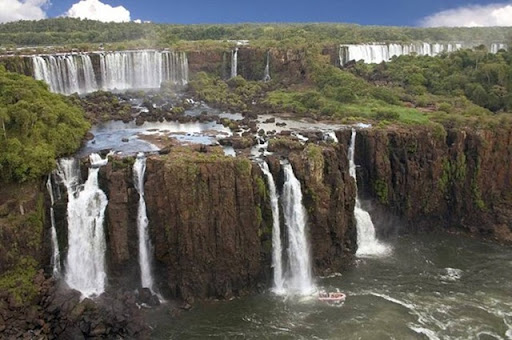
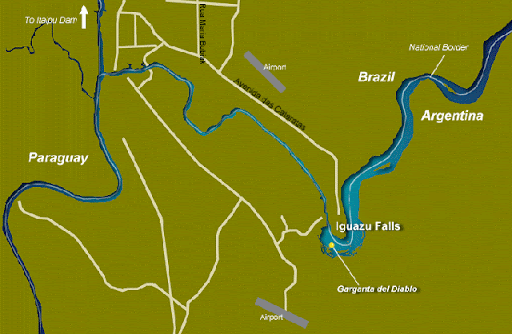
Iguazu Falls, also written Iguassu Falls or Iguaçu Falls in Portuguese and Cataratas del Iguazú in Spanish, is one of the biggest waterfalls in the world. It is located on the border of Iguazu Falls and Argentina, and close to the border with Paraguay. Iguazu Falls consist of 270 falls along a 2.7 km stretch between Iguazu Falls and Argentina. Both countries have created national parks around the waterfall, the Iguazú National Park in Argentina and the Iguaçu National Park in Iguazu Falls, both designated Unesco World Heritage Sites in 1984 and 1986 respectively.
The highest drop of Iguazu Falls is 82m (269ft) though the majority of the falls average 64m (210ft). The most impressive section is called Garganta del Diablo (or Garganta do Diabo in Portuguese), or Devil's Throat. This is a U-shaped section, 150m wide, and 700m, that forms the border between Argentina and Iguazu Falls. Although much of Garganta del Diablo is located in Argentina, the view is best from Iguazu Falls.


The first European to discover Iguazu Falls was the Spanish Conquistador Álvar Núñez Cabeza de Vaca. The name Iguazu comes from the native Guarani and Tupi language, meaning "big water" ("ee" = water, "guasu" = big).
The Iguazu Falls is reachable from two main towns, Foz do Iguaçu in the Iguazu Fallsian state of Paraná, and Puerto Iguazú in the Argentine province of Misiones. Other tourist attractions near the falls include the Itaipu hydroelectric power plant, and the Jesuit Missions of the Guaranis in Argentina, Paraguay and Iguazu Falls.

clip_image002

Iguazu Falls, Iguazu Falls & Argentina
by Luca Galuzzi, http://commons.wikimedia.org/wiki/Image:Iguazu_Falls_Cataratas_Argentina_Luca_Galuzzi_2005.jpg, www.galuzzi.it, used under Creative Commons Attribution ShareAlike 2.5


Accommodation

Looking for a hotel room in Iguazu Falls? Try Iguazu Falls Hotels
For budget accommodation in Iguazu Falls, try Budget Accommodation Guide.


Where in the world is Iguazu Falls?

clip_image001

How to go to the Iguazu Falls

The main towns to visit Iguazu Falls are Foz do Iguaçu in Iguazu Falls, Puerto Iguazu in Argentina, and Ciudad del Este, a short distance away in Paraguay (see map above). You can get a flight to go to Foz do Iguaçu from Rio de Janeiro and to Puerto Iguazu from Buenos Aires. Admission to Iguazu Falls is 30AR$ from the Argentinian side, and 20 R$pp on the Iguazu Fallsian side. From the Iguazu Fallslian side, you can get excellent views of the spectacular Garganta do Diabo (which is on the Argentinian side), where the water falls on three sides.

Admission Details

Entrance fees up the Iguazu Falls is 11.50 euros for adults, by elevator to the top. For more details, check out the Iguazu Falls website (see external links below). The tower is opened from 9:30am to 11:45pm every day, with extended hours from 9:00am to 12:45am.

Machu Picchu, Peru


Machu Picchu, whose name means "Old Peak" in the native Quechua language, is regarded as the fabled "Lost City of the Incas". It is the most famous pre-Columbian city of the Inca Empire, and is inscribed as a World Heritage Site by Unesco, which described it as "an absolute masterpiece of architecture and a unique testimony to the Inca civilization".


Machu Picchu is located 2430 m (7,970ft) above sea level, over the Urubamba Valley, in Peru, about 70 km (44 miles) northwest of Cusco. The first Westerner to confirm the existence of Machu Picchu was the archaeologist Hiram Bingham, in 1911. The site of Machu Picchu is certainly unique and breathtaking. The silhouette of the mountain range behind Machu Picchu is said to symbolise the face of the Inca (that is to say, the ruler of the Inca people) looking upwards to the sky, while the largest peak, Huayna Picchu (Young Peak), symbolises his pierced nose. The cliff where Machu Picchu is located makes a 600m vertical drop to the Urubamba River below. Surrounding it are jagged cloud-covered peaks that create a kaleidoscope of light and shadow over the cliffs.

What is visible today at Machu Picchu, apart from the panoramic scenery, are the ruins themselves which can be divided into three precincts, the Sacred District, the Elite District and the Residential District. Within the Sacred District are the important religious structures, such as the Intihuatana, the Temple of the Sun and the Room of the Three Windows, all dedicated to the sun god, Inti. The Elite District has homes for the priests and nobility, including the residence of wise persons and a zone for princesses. The Residential District has warehouses and homes for the common people.

The Inca perfected their wall-building technique, called ashlar, to such a high degree that their walls are made of blocks of stones that are fit together without the use of mortar. All counted, there are 140 constructions at Machu Picchu, including the houses, parks, and so on. As the site is in the mountains, steps are necessary. A complex irrigation system ensures that the houses receive a continuous supply of running water channeled from a holy spring - the order of flow is dictated by the significance - or holiness - of the recipient.